
· by Michael Blair, Nashville's Cleaning Service
A house with a dog or a cat in it is not simply a dirtier house. Hair, dander, odor and tracked-in soil each behave differently, and each needs its own method. The complaint we hear most after a thorough clean is odor: the house looks spotless and still smells faintly of dog. When we hear that, we stop looking at the surface and start looking underneath it.
Hair goes where air goes
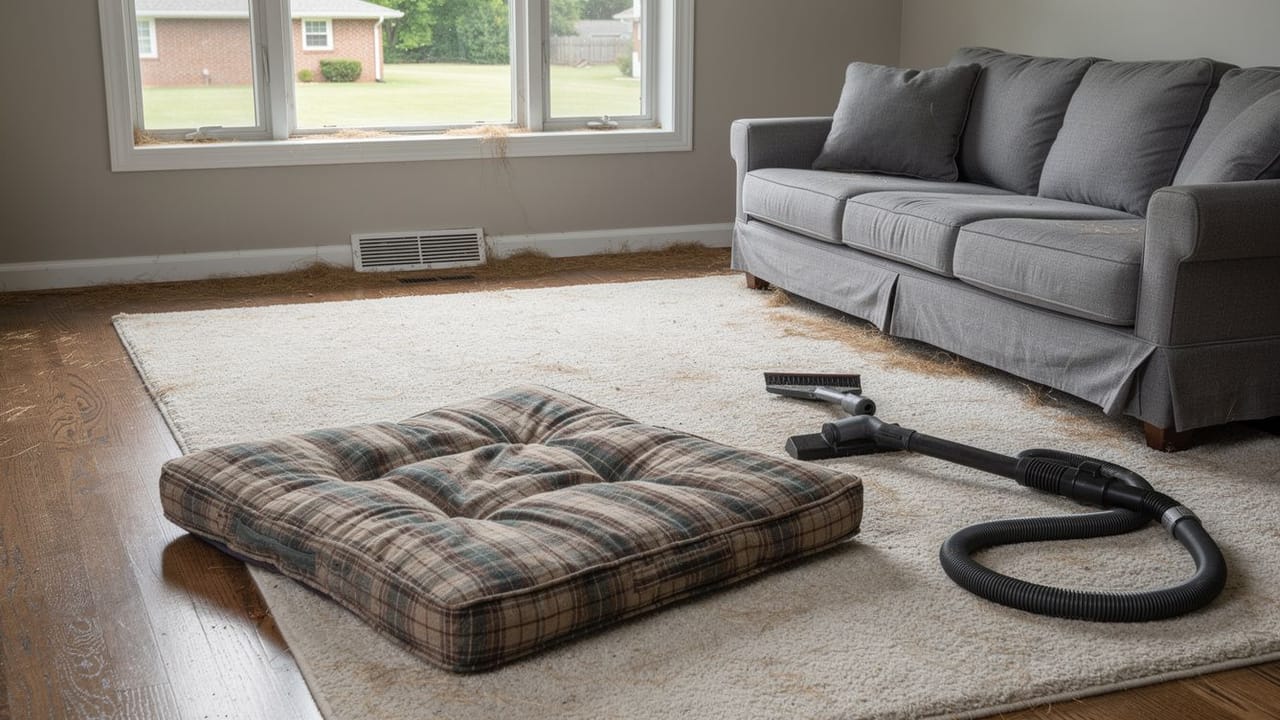
We clean a pet house from the edges in. In the houses we work in, hair ends up along the baseboards, under the sofa and the beds and on the return air grilles, so that is where we start, and we check the HVAC filter while we are there. The open middle of the room comes last. Hair is the part you can see, though the National Institute of Environmental Health Sciences’ page on pet allergens describes fur as merely a carrier for the allergens themselves.
On carpet and upholstery we pull a rubber squeegee or a damp rubber glove across the pile, which brings up hair woven into the fibers that the vacuum left behind. On hard floors the broom stays in the closet. We use a microfiber dust mop, which holds the hair instead of pushing it around the room.
Is pet hair or dander the allergy problem?
What people react to is dander. NIEHS describes it as tiny, even microscopic, flecks of skin shed by pets, and says cat allergen is also carried in saliva that sticks to the fur when a cat grooms, and in the urine of male cats. The same page says these allergens are buoyant enough to stay airborne, last on carpets and furniture for months, and travel on clothing into rooms the pets never enter. The amount that settles into soft surfaces is large. A study of British homes by Custovic and colleagues measured about 260 times more cat allergen in the living room carpets of houses with a cat than in houses without one.
That makes it an air and textile problem, and the research on each tool is more mixed than people expect. NIEHS advises vacuuming regularly with a HEPA filter or a double-layered microfilter bag, ideally while the allergic person is out, and dusting often with a damp cloth. Yet when a Swedish trial in 52 homes with allergic children gave families new HEPA and microfilter vacuums, cat and dog allergen in their dust did not drop over five weeks. Laundry did far better in a Yonsei University study of washing machines and allergens: only 0.3 to 1.3 percent of dog allergen was left on the sheets at every temperature tested, and the hot 140°F cycle mattered for dust mites, killing all of them where the 86°F and 104°F cycles killed under 10 percent.
For the furnace, the EPA’s guide to air cleaners in the home suggests a filter rated at least MERV 13, or as high as the system will take, and says most systems can handle MERV 13 provided the filter is replaced frequently. Pollen and dust mites add to the same load, and our post on cleaning for allergy season covers that side of it.
- HEPA filter or double-layered microfilter bag, run while the allergic person is out
- Pet bedding and throws washed often, hot water if dust mites are a concern
- MERV 13 furnace filter if the system takes it, changed frequently
- Rubber squeegee for embedded hair in carpet and upholstery
- Microfiber dust mop rather than a broom on hard floors
Why odor comes back after cleaning
When a pet smell returns soon after a clean, we look below the surface. Urine that soaked through a carpet into the pad, or down to the subfloor, sits where nothing that cleans the top of the carpet can reach it, so the carpet can be clean and the source still be there.
On urine spots we use an enzyme cleaner, enough of it to soak as deep as the urine went, and we leave it wet for the full time on the label. Where it has gone into the pad or the subfloor, we tell you so, because at that point it is a flooring question more than a cleaning one. An air purifier will not solve it either. The EPA guide puts reducing or removing the source, along with fresh outdoor air, ahead of any filter, and says filtration does not replace controlling the source.
What should you tell a cleaner about your pets?
Say there are pets, and where the trouble spots are, when you book. A standard clean is scoped for a house without them, and we plan more time for one with a shedding dog or a litter box, whether it is a one-off deep clean or a recurring visit. If anyone in the house has allergies, tell us that too, so we bring the HEPA vacuum and do the vacuuming while they are out.
Be clear about products as well, and cats need the most care. A Tufts study of how cats process drugs found the domestic cat has a much lower capacity than most mammals to break down a group of phenolic chemicals. When the ASPCA Animal Poison Control Center reviewed 443 cases of dogs and cats exposed to undiluted tea tree oil, it found lethargy, weakness, loss of coordination and tremors within hours, with younger and smaller cats at greatest risk. Those cases involved pure oil, most of it used on purpose, not a diluted cleaner. It is still why we ask about pets before we choose products and keep concentrated essential oils out of pet houses. If you want to go over what your house needs, ask us for a free estimate.
Sources
- NIEHS (NIH), Pet Allergens — Fur is a carrier for allergens; dander is microscopic skin flecks; cat allergen in saliva and male cat urine; airborne, lasts on carpets and furniture for months, carried on clothing; HEPA or double-layered micro filter bag vacuum while the allergic person is out; damp dusting; bedroom air cleaner; avoid ozone-producing ionic cleaners; bathe dogs twice a week
- US EPA, Guide to Air Cleaners in the Home — MERV 13 or as high as the system allows, replaced frequently; source control and ventilation come first and filtration does not replace them; portable HEPA cleaners improved some allergy symptoms in multiple studies, not always majorly
- Custovic A et al., Distribution, aerodynamic characteristics, and removal of the major cat allergen Fel d 1 in British homes, Thorax (1998) — About 260-fold more Fel d 1 in living room carpets of homes with a cat; a HEPA air cleaner significantly reduced airborne Fel d 1
- Munir AK et al., Indirect contact with pets can confound the effect of cleaning procedures for reduction of animal allergen levels in house dust, Pediatr Allergy Immunol (1994) — 52 Swedish homes without pets; HEPA and microfilter vacuums did not reduce Fel d I or Can f I in dust over 35 days
- Choi SY et al., Optimal conditions for the removal of house dust mite, dog dander, and pollen allergens using mechanical laundry, Ann Allergy Asthma Immunol (2008) — Can f 1 remaining after washing 0.3% to 1.3% at all modes; 60 °C (140°F) killed all dust mites, 30 °C and 40 °C killed 6.5% and 9.6%
- Court MH, Greenblatt DJ (Tufts), Molecular genetic basis for deficient acetaminophen glucuronidation by cats, Pharmacogenetics (2000) — Domestic cat has a significantly lower capacity to glucuronidate planar phenolic compounds than most other mammals
- Khan SA et al. (ASPCA Animal Poison Control Center), Concentrated tea tree oil toxicosis in dogs and cats: 443 cases (2002-2012), JAVMA (2014) — 100% tea tree oil caused CNS depression, paresis, ataxia or tremors within hours; 89% intentional use; younger and lighter cats at greater risk
FAQ
Cleaning a House That Has Pets in It — questions
Why does my house still smell like dog after cleaning?
Usually because the source is in a material rather than on it: urine that soaked into the carpet pad, the subfloor or upholstery foam. Cleaning the surface does not reach it, and an air purifier only treats the air. We treat what we can reach with an enzyme cleaner applied deep and left wet, and if it has gone into the pad or subfloor we will tell you, since cleaning alone cannot get to it there.
Do air purifiers help with pet allergies?
They can help. The EPA says multiple studies of portable HEPA air cleaners found improvements in one or more allergy or asthma symptoms, though not always major ones, and a British study of homes with cats found a HEPA cleaner lowered airborne cat allergen. A purifier only cleans the air that passes through it, so what has settled into carpet and upholstery still has to be vacuumed and washed out. NIEHS suggests one in the allergic person’s bedroom and warns against ionic cleaners that can produce ozone.
How often should a house with pets be cleaned?
More often than the same house without them, and vacuuming matters more than the full clean. NIEHS advises vacuuming regularly with a HEPA-filter cleaner while the allergic person is out, and says bathing a dog at least twice a week may decrease allergens. Between our visits, vacuuming the routes the pets use most is what keeps the house ahead of the hair and dander.
What is the best way to get pet hair out of carpet?
Vacuum first, then drag a rubber squeegee or a damp rubber glove across the pile to pull up the hair woven into the fibers that the vacuum missed. Start along the baseboards and under the furniture, where hair collects, and finish in the open middle of the room. On hard floors, a microfiber dust mop beats a broom.