
· by Michael Blair, Nashville's Cleaning Service
The big meals of late November put red wine, gravy, cranberry sauce and coffee over carpet for hours at a time, and something always lands on it. The first few minutes decide most of what follows. Today’s carpet is built to let go of a lot of spills if they are handled gently and quickly, and to hold on to the ones that get scrubbed or left.
Here is what to do first, the solutions the carpet industry recommends, and why a spot that looked gone can come back.
What should you do first when wine spills on carpet?
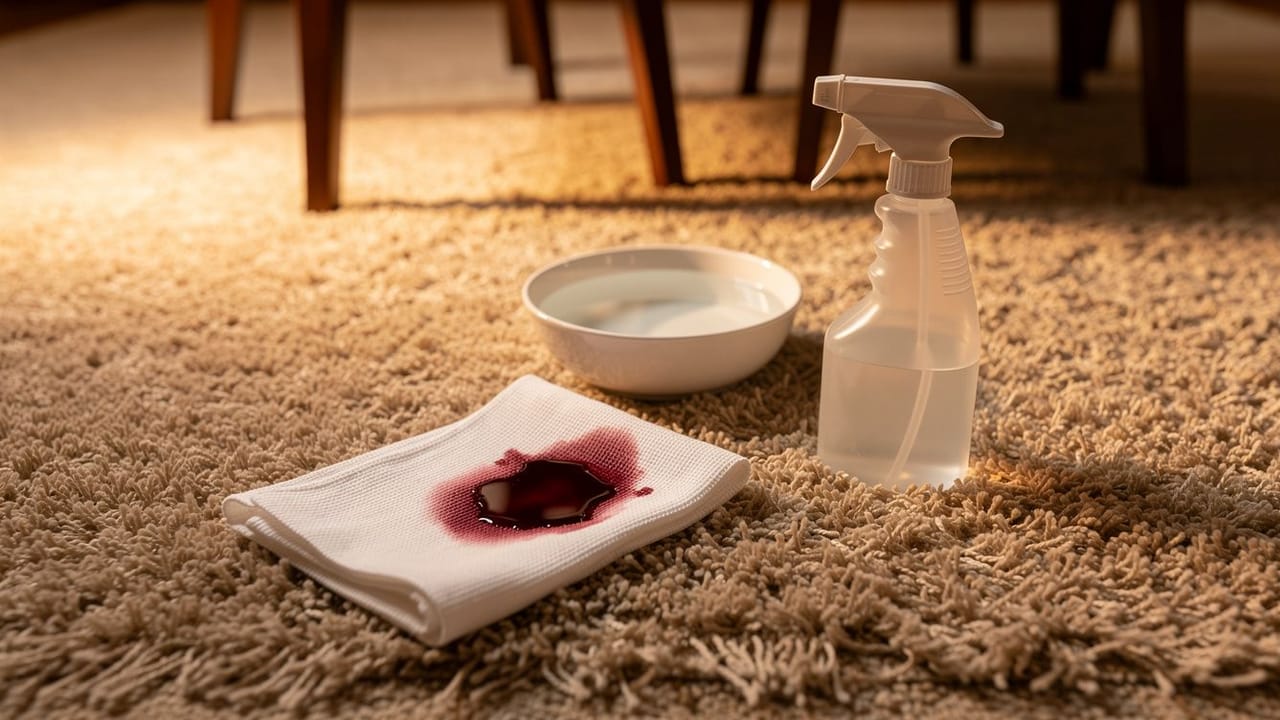
The first thing to do when wine spills on carpet is blot it with a dry white cloth or plain white paper towels, and keep blotting until nothing more transfers. The Carpet and Rug Institute’s Carpet and Rug Care Guide says not to scrub, because scrubbing distorts the pile. It also says the longer a spill waits, the more likely it becomes permanent.
Thicker spills come off before anything wet goes on. The guide says to scrape semi-solids up gently with a rounded spoon, which covers gravy, mashed potatoes and cranberry sauce, and to break up and vacuum solids. Shaw’s carpet care and maintenance guidelines say the same about food and add one direction: work from the outside of the spot toward the middle, so it does not spread.
What household solution takes a stain out of carpet?
The Carpet and Rug Institute lists three household solutions, and the mildest is a detergent mix: a quarter teaspoon of clear dishwashing liquid with no bleach, lanolin or optical brighteners in one cup of warm water, left on the spot for 10 to 15 minutes. The others are one cup of white vinegar in one cup of water, and one tablespoon of household ammonia in a cup of water, which the guide warns can change the color.
Each one gets tested first. The guide says to put a few drops on a hidden area, hold a white cloth on it for 10 seconds, and look at both for color transfer or damage. Then the solution goes on a white cloth, not poured onto the carpet, sits for about 10 minutes, and is worked in gently and blotted. Repeat as long as the spill keeps coming up on the cloth.
The guide also names what not to use. Automatic dishwasher detergent can contain bleach that destroys carpet color, and laundry detergent can carry optical brighteners that dye the fiber.
Why does a carpet stain come back after cleaning?
A carpet stain usually comes back because cleaning solution or a sticky residue was left in the fibers, and it catches dirt from shoes over the next week. The Carpet and Rug Institute says soiling that shows up after spot cleaning is most often caused by exactly that. Shaw’s guidelines say to always follow up with water to take out detergent residue.
So the last step matters as much as the first. The institute’s method is to rinse the area with cold water and blot until all the solution is gone, then lay a half-inch layer of white paper towels over it and weigh them down with something flat and heavy that will not bleed color, changing the towels as they soak up moisture. We leave the weight on until the towels come up dry.
What can void a carpet stain warranty?
Using cleaners the manufacturer has not approved can void a carpet stain warranty. Shaw’s guidelines say not to use household cleaners other than the ones in its program, list bleaches, tile cleaners, mildew removers and oven cleaners among products harmful to carpet, and say damage from unapproved products will not be covered. The Carpet and Rug Institute warns that some spot cleaners have a pH above 10 or optical brighteners that can distort color and void warranties.
Shaw also requires professional hot water extraction at least once every 18 months. If your carpet is under warranty, read it before reaching for anything stronger than the mild solutions above.
Spot work like this is part of a deep clean, and we test every spot before we treat it. A stain that keeps coming back, or one the mild solutions will not touch, belongs with a carpet-cleaning firm, and we will say so. Our post on cleaning products worth owning covers what else to keep under the sink. If you are hosting in Brentwood or nearby, book a cleaning before or after.
Sources
- Carpet and Rug Institute, Carpet and Rug Care Guide — Blot, do not scrub; scrape semi-solids; pretest for 10 seconds; detergent, vinegar and ammonia solutions; never dishwasher or laundry detergent; rinse with cold water; weighted white towels; residue causes resoiling; pH above 10 and optical brighteners.
- Shaw Industries, Carpet Care and Maintenance Guidelines — Blot from the edge in; follow up with water; products harmful to carpet; unapproved products not covered by warranty; hot water extraction at least every 18 months.
FAQ
Red Wine or Gravy on the Carpet: What to Do First — questions
Should you scrub a stain on carpet?
No. The Carpet and Rug Institute says scrubbing distorts the pile, and Shaw warns that rubbing can leave a fuzzy area by untwisting the yarn. Blot with a dry white cloth instead, working from the outer edge of the spot toward the center so it does not spread, and repeat until nothing more transfers to the cloth.
Can you use dish soap on carpet stains?
A very small amount of the right kind. The Carpet and Rug Institute’s detergent solution is a quarter teaspoon of clear dishwashing liquid, with no bleach, lanolin or optical brighteners, in a cup of warm water. It warns never to use automatic dishwasher detergent or laundry detergent, and to rinse thoroughly afterward.
Will bleach take a stain out of carpet?
Bleach is more likely to leave a permanent pale spot than to remove the stain. Shaw’s care guidelines say bleach cannot be used as a cleaner and list bleaches among products harmful to its carpet, and the Carpet and Rug Institute warns that the bleaching agents in dishwasher detergent can destroy carpet color.
How do you test a carpet spot cleaner first?
The Carpet and Rug Institute says to apply a few drops to an area nobody sees and hold a white cloth on the wet spot for 10 seconds. Inside a closet works well. If the carpet changes color or the cloth picks up dye, choose another solution before treating the stain.