
· by Michael Blair, Nashville's Cleaning Service
Most of what a house needs comes down to a handful of bottles and a stack of cloths, and what is in the bottle matters more than the brand on the front. Two pairings are dangerous enough to come before anything else on the list.
Why is mixing bleach and ammonia dangerous?
Bleach and ammonia together give off chloramine gas. A CDC report on household cleaning, published in MMWR in June 2020, warns that mixing bleach with ammonia or vinegar, or heating it, can release chloramine and chlorine gases that may cause severe lung damage when inhaled, and it advises diluting bleach in room-temperature water unless the label says otherwise. Some glass cleaners contain ammonia, so read the label before you take one to a shower you’ve just scrubbed with bleach.
Vinegar is the acid the report names, and we keep every other acidic cleaner away from bleach too. In the survey behind it, 58 percent of the adults asked knew bleach shouldn’t be mixed with ammonia, and only 35 percent knew the same about vinegar. In a bathroom we use one product, rinse with plain water and only then reach for the next, the order our post on bathroom mold and mildew follows. If anyone breathes fumes from a mixed batch, the Tennessee Poison Center’s free hotline answers around the clock at (800) 222-1222.
What cleaning products does a house actually need?
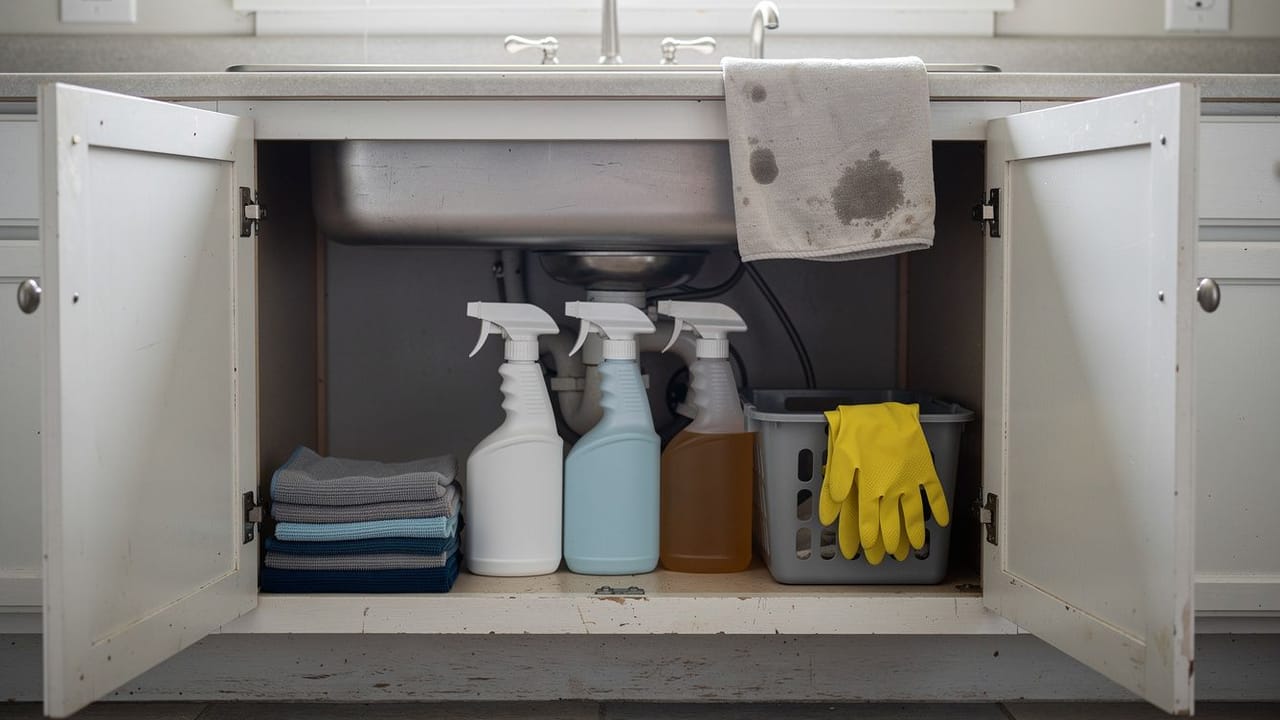
For most houses we’d keep five things under the sink: a pH-neutral all-purpose cleaner for everyday surfaces, a degreaser for the stove and range hood, a descaler if your water leaves a crust on faucets and glass, a cleaner labeled safe for stone if you have marble or limestone, and a stack of microfiber cloths. The descaler is there for hardness, which the USGS Water Science School explains as dissolved calcium and magnesium; that water leaves soap scum behind, and once heated it can drop solid calcium carbonate scale. If you’re on Metro water, its Water Quality page links the annual report, the place to check your own water before buying for it, and our post on hard-water stains covers where a descaler goes and where it shouldn’t.
Anything beyond that tends to be a product for one job. The grout, baseboards and baked-on kitchen grease that a weekly wipe never gets to are what our deep cleaning visit is for.
- Never mix bleach with ammonia, vinegar or another acid
- pH-neutral all-purpose for most surfaces
- Descaler where hard water leaves scale
- Degreaser for the stove and range hood
- Stone-safe cleaner if you have marble or limestone
- Microfiber cloths, washed without fabric softener
Where dwell time matters
Every disinfectant label carries a contact time. EPA’s guide to reading a disinfectant label defines it as the time the product must remain on the surface to be effective, and its example is a label that calls for 10 minutes: the surface stays visibly wet for all ten, and if it has dried by the five-minute mark, more product goes on. The agency repeats the visibly-wet rule on its List Q of disinfectants for emerging viral pathogens.
So spraying and wiping straight away cleans a counter, and it doesn’t disinfect it unless the label’s contact time was met. We give descalers and degreasers their time as well, following the label instead of scrubbing the moment they go on, and on our recurring cleans that means the bathroom gets sprayed first and wiped last.
Microfiber
We dust with microfiber dampened with plain water and save the sprays for the surfaces that need them. Bathroom cloths and kitchen cloths stay in separate piles and never trade places.
Ours go through the wash with detergent only, no fabric softener and no dryer sheet, and anything new gets washed the way its care tag says. If you’d rather hand the cloths and the bottles to someone else, ask us for a free estimate.
Sources
- CDC, MMWR 69(23), Knowledge and Practices Regarding Safe Household Cleaning and Disinfection for COVID-19 Prevention, United States, May 2020 (PMC copy) — Bleach mixed with ammonia or vinegar, or heated, can release chloramine and chlorine gases causing severe lung damage; room-temperature water for dilution; 58% and 35% survey figures
- Tennessee Poison Center (Vanderbilt University Medical Center) — Free 24/7 poison help hotline, (800) 222-1222
- USGS Water Science School, Hardness of Water — Hardness is dissolved calcium and magnesium; soap scum; heated hard water forms calcium carbonate deposits
- Metro Nashville Water Services, Water Quality — Links the annual Water Quality Report for Metro water customers
- US EPA, Selected EPA-Registered Disinfectants — Contact time defined; surface visibly wet for the whole contact time; 10-minute example, reapply if dry after 5 minutes
- US EPA, Disinfectants for Emerging Viral Pathogens (EVPs): List Q — Surface should stay visibly wet for the full contact time
FAQ
Cleaning Products Worth Owning — questions
What cleaning products should never be mixed?
Bleach with ammonia, which gives off chloramine gas, and bleach with vinegar, which gives off chlorine gas. A 2020 CDC report warns that both gases can cause severe lung damage when inhaled, and that heating bleach is a risk too. We keep bleach away from other acidic cleaners as well, and rinse a surface with plain water before switching products.
Does disinfectant need to sit on the surface?
Yes. Each label gives a contact time, and the EPA says the surface should stay visibly wet for all of it, with more product applied if it starts to dry. Wipe it off early and you have a clean surface that has not been disinfected.
How should microfiber cloths be washed?
By the care tag on the cloth, since that is the maker’s own instruction. We wash ours with detergent and nothing else, leave out fabric softener and dryer sheets, and run the bathroom cloths in a separate load from the kitchen ones.
Which cleaner is best for everyday cleaning?
A pH-neutral all-purpose cleaner covers most everyday surfaces, and plain water on a microfiber cloth handles the dusting. Add a degreaser for the stove and range hood, a descaler where hard water leaves a crust, and a stone-safe cleaner for marble or limestone. Most other products on the shelf are made for a single job.