
· by Michael Blair, Nashville's Cleaning Service
Nashville’s tap water is moderately hard. Metro Water Services’ 2025 Consumer Confidence Report lists total hardness at 100.5 mg/L on average in its 2023 testing, ranging from 88.5 to 128.4, which works out to about 6 grains per gallon by the report’s own conversion. The USGS Water Science School classes 61 to 120 mg/L as moderately hard, so the top of that range edges into hard. Metro traces it to limestone deposits in Tennessee and eastern Kentucky and says its treatment process doesn’t remove it, and homes on a well or another utility will have numbers of their own. What it leaves on glass and chrome is mineral, and it needs a different approach from everyday grime.
Why won’t regular cleaner remove hard water stains?
Detergents are made to lift grease and soil. The film on a shower door is something else: USGS calls the spots and film on glassware hard-water residue, and adds that heated hard water can form solid deposits of calcium carbonate. A mineral calls for an acid, and the same USGS page explains why plain white vinegar works on it, since its acidity helps dissolve the mineral particles so they rinse away.
We don’t try to scrub it off. The acid goes on, sits long enough to work, and then a non-scratch pad finishes the job; a thick crust gets a second round instead of a rougher pad. On glass that has gone years without attention, we schedule the removal as part of a deep clean so there’s time to let the acid do the work.
What removes hard water stains from glass and chrome?
On glass, chrome and ceramic tile we use white vinegar or a descaler made for the job, left to dwell before a pad touches it. A descaler earns its place in our post on cleaning products worth owning for exactly this job.
Natural stone is the exception. We keep vinegar and every other acid off marble, travertine and limestone and use a cleaner labeled safe for stone, which means slower going on any scale there. If you aren’t sure what your shower walls or vanity top are made of, treat them as stone until you know, and the grout between ceramic tiles has its own rules, covered in our post on cleaning tile floors and grout.
- Glass, chrome and ceramic: vinegar or a descaler, with time to dwell
- Marble, travertine and limestone: a stone-safe cleaner, never vinegar
- Toilets and drains: an acid gel, given time to work
- Faucets: the aerator soaked in descaler overnight
- Shower glass: a squeegee after every shower
The aerator trick
Scale builds up inside the plumbing too. The USGS explains that hard water moving through a pipe over the long term can leave scale that narrows it, so less water gets through and the pressure drops. When a faucet’s flow weakens, the first thing we check is the aerator, the small screen at the tip of the spout, because it is easy to unscrew, soak in descaler and refit. If the flow still doesn’t come back after that, the restriction is further in and it’s a plumber’s call.
Shower heads get the same treatment without coming off the wall. We fill a plastic bag with descaler, tie it around the head so the face sits in the liquid, and leave it overnight.
Preventing it
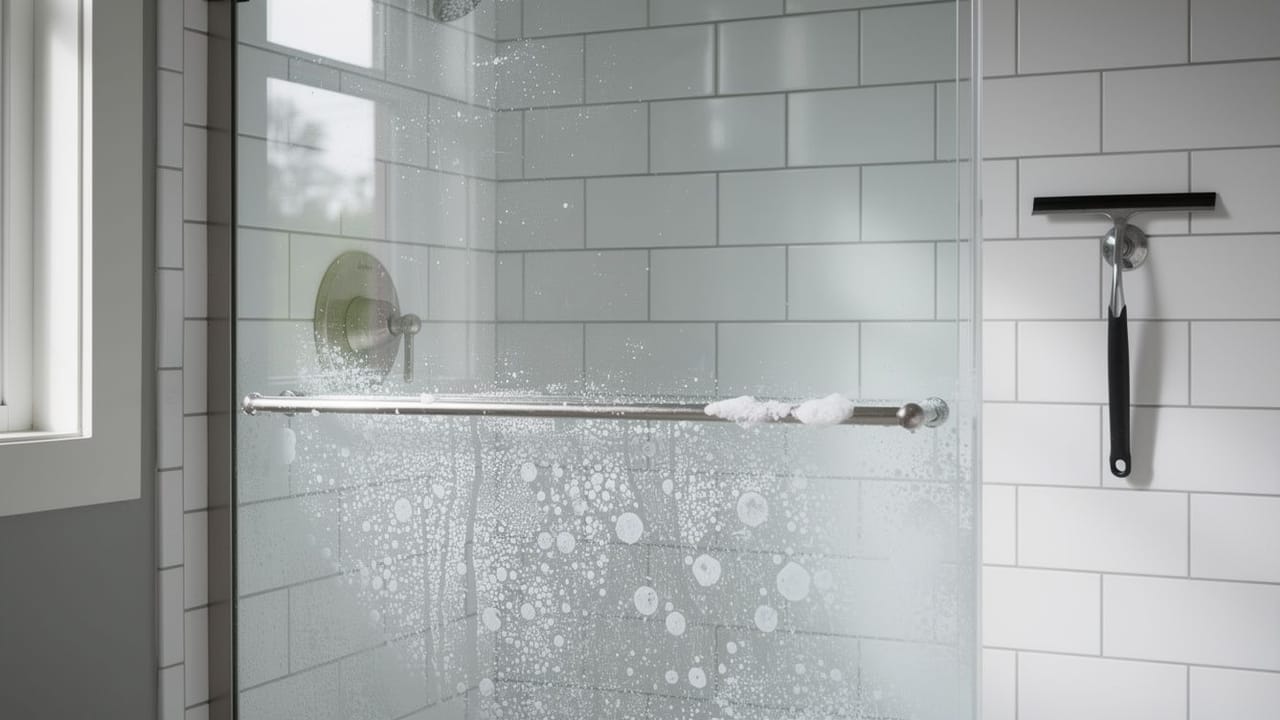
The habit we suggest to anyone with glass shower doors is a squeegee pass after every shower. Water wiped off the glass isn’t left there to dry into another layer of film, and the next descale is a lighter one.
A water softener goes after the cause across the whole house, and the stains are only part of the case for one. The USGS notes that scale from heated hard water can reduce the life of equipment, raise the cost of heating water and lower the efficiency of electric water heaters. Whether one pays off in your house depends on your own water, and USGS says the hardness at a particular home should come from the local water utility, which for Metro customers is the report above. If the glass in your bathroom is already past what a squeegee can keep up with, ask us for a free estimate.
Sources
- Metro Water Services (Nashville), 2025 Consumer Confidence Report — Total hardness 100.5 mg/L average, range 88.5 to 128.4 (2023 data); 17.1 mg/L equals 1 grain per gallon; hardness comes from limestone deposits and treatment does not remove it
- USGS Water Science School, Hardness of Water — 61 to 120 mg/L is moderately hard; spots and film on glassware are hard-water residue; heated hard water forms calcium carbonate scale that shortens equipment life and lowers electric water heater efficiency; vinegar dissolves mineral; scale in pipes lowers pressure; home hardness comes from the local utility
FAQ
Beating Nashville Hard Water Stains — questions
Why is my shower glass permanently cloudy?
Usually it is hard-water residue that has built up over months or years, the same kind of film USGS describes on drinking glasses. It comes off with vinegar or a descaler given time to dwell, sometimes over several rounds. If the glass stays cloudy after a careful descale, the surface itself may be damaged rather than coated, and cleaning will not bring it back.
Can I use vinegar on all surfaces?
No. We use it on glass, chrome and ceramic tile, and keep it and every other acid off marble, travertine, limestone and stone countertops, where a cleaner labeled safe for stone is the right choice. For a faucet with a specialty finish, check the manufacturer’s care instructions before putting any acid on it.
Would a water softener be worth it in Nashville?
It depends on the house. Metro Water Services reports Nashville’s total hardness at about 100 mg/L, roughly 6 grains per gallon, which USGS counts as moderately hard. A softener treats the cause rather than the stains, and USGS notes that scale from heated hard water can shorten the life of equipment and lower the efficiency of electric water heaters. It is a real cost, so look at your own utility’s or well’s numbers before deciding.
How do you remove years of hard water stains?
Patiently, in rounds. Put white vinegar or a descaler on the glass, chrome or ceramic, let it dwell, then finish with a non-scratch pad, and give a thick crust another round instead of a rougher pad. On glass left for years, we book the removal as part of a deep clean so the acid has time to work.